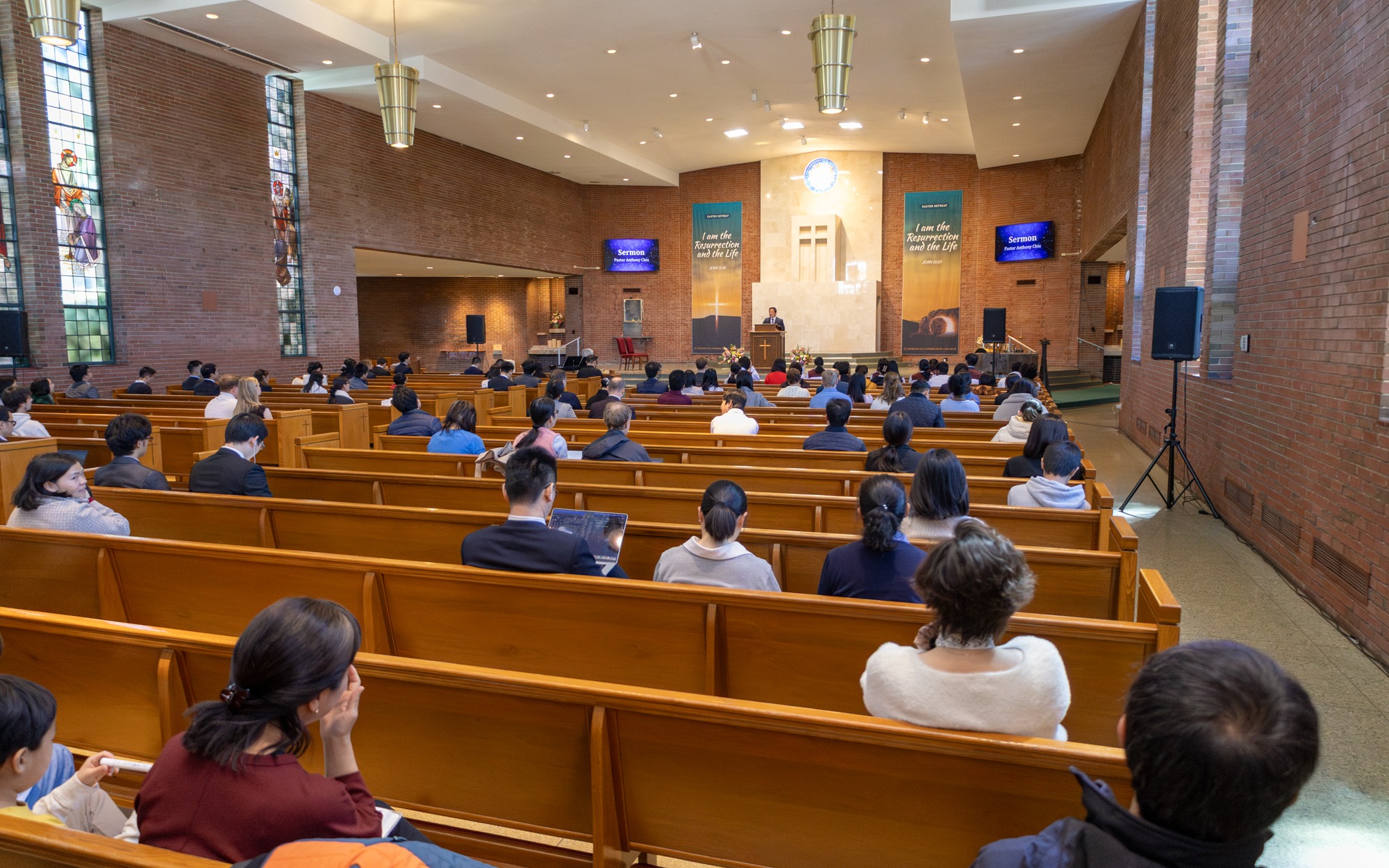
Sermon Manuscript
Emmaus Road
The risen Lord walks with discouraged disciples, opens the Scriptures, and reveals that the cross was not defeat but redemption.
Public Excerpt
“We had hoped that He was the one to redeem Israel.” Notice the tense—had hoped. Their faith was not entirely absent, but it had collapsed under the weight of what they had witnessed. They truly believed Jesus could be the Messiah. But the cross shattered their expectations. But what they did not realize yet was this: The very One they thought they had lost was already walking beside them, resurrected from the dead.
The Lord often walks beside us even when we do not recognize Him. Yet through His Word and His presence, our eyes are opened and our hearts burn within us once again.
It is True! The Lord has Risen (Luke 24:13-35)
Happy Easter, everyone!
We have finally arrived at Easter Sunday. Over the past 40 days of Lent, we have reflected deeply on the cross of Jesus Christ and His suffering. And today, we come to the resurrection—the fulfillment and completion of all that the cross means.
To be honest, there is so much I had hoped to share today. Last night, I told my wife it took me nine hours to prepare for this sermon. She frowned at me and said, “You do know you only have 40 minutes, right?”
There is so much to say, but I need to keep this within a time limit—before our children run out of patience in Sunday School. I do wish they could receive grace in proportion to the length of sermons like we do. But until then, I’ll need to keep the time.
So today, I’ll borrow a line from the genie in Aladdin: all this vast, cosmic truth about the cross and the resurrection… is now contained in one small, 40-minute sermon.
A pastor once shared with me that reading the Word of God is like digging up potatoes from a field. Just when you think you have gathered everything, you pull a little more at the roots—and still more keep coming up. There is an endless richness to Scripture, a depth of wisdom and grace that continues to reveal itself the more you return to it.
For those who have spent many Easters with us, this passage may already be familiar. You likely know how the story unfolds. Yet today, I want us to return to it once again.
Because like that field, I believe that as we dig into this passage anew, we will discover fresh grace—truths that perhaps we have not seen before, or truths we need to see again.
Luke 24:13–16
Here we see two disciples traveling to Emmaus, a village about seven miles from Jerusalem. These were not casual followers. They were likely devoted disciples, men who had given their lives to the hope of God’s Kingdom. But that hope now seemed shattered. Jesus had been arrested, crucified, and buried. And so, we find them on the road home—hearts heavy, eyes filled with sorrow, and minds clouded by despair.
Emmaus lay to the west of Jerusalem. As they walked, the sun was setting before them. It is a striking image: two disciples moving toward the fading light, leaving behind the place where their hope had died.
At that very moment, Jesus Himself drew near and walked with them—right between them. It was not so dark that they could not see Him. In fact, with the glow of the setting sun, their faces may have even reflected the light. And yet, despite His nearness, they did not recognize Him.
This is what makes the passage so mysterious.
William Barclay once reflected on this scene, noting that the disciples were walking toward the sunset. But should not the Christian life be a journey toward the sunrise rather than the sunset?
“The Christian goes onward, not to a night which falls, but to a dawn which breaks.”
Barclay suggests that Scripture is showing us something deeper about their condition. They were walking not only in physical decline of light, but in spiritual dimness—burdened by disappointment, unable to perceive what was right before them.
This leads us to the central question of the passage: Why could they not recognize Jesus—the very One they had followed for three years? It is a puzzling question. And it confronts us personally as well: If Christ were to stand before us today, would we recognize Him?
We may hesitate to answer yes. After all, we have not seen Him face to face as the disciples had. But the deeper mystery is this: even those who had walked with Him still failed to recognize Him after His resurrection—and not just once, but multiple times.
However, the Lord was not hiding Himself. Rather, the disciples were hindered by the assumptions they carried. They were, in a sense, blinded by their own expectations. They thought they knew what the Messiah should be, what He should do, and how His story should unfold. And because of that confidence, they failed to recognize Him when He stood right before them.
This is a reminder to us: it is not that Christ is absent, it is that we may be too certain of our own understanding to truly see Him.
Luke 24:17–21
As the two disciples walked along the road to Emmaus, their faces were downcast. Their posture revealed what their words would soon confirm—a deep and overwhelming sorrow.
When the Lord asked them what they were discussing, one of them named Cleopas responded with surprise, almost disbelief: “Are you the only visitor to Jerusalem who does not know the things that have happened there in these days?” And then he began to recount the very reason for their grief.
They spoke of Jesus of Nazareth—a man they believed to be a prophet, mighty in word and deed before God and all the people. They had seen His works. They had heard His teaching. They had placed their hope in Him. But now, He had been handed over to the chief priests, condemned, and crucified. And this had all happened just three days ago.
With His death, their hopes seemed to die as well. Cleopas makes this painfully clear:
“We had hoped that He was the one to redeem Israel.”
Notice the tense—had hoped. Their faith was not entirely absent, but it had collapsed under the weight of what they had witnessed.
They truly believed Jesus could be the Messiah. But the cross shattered their expectations.
How could the Son of God—the Redeemer of Israel—be handed over to sinful men and die? This did not align with the God they had come to know through the Scriptures.
Yet what they saw at the cross appeared to tell a different story. Jesus was arrested, beaten, and crucified. From their perspective, justice had not prevailed—evil had. The One they trusted seemed to have been overcome.
Even more troubling was what the Law itself declared:
Deuteronomy 21:23
it is written that anyone who is hung on a tree is under God’s curse. And there, before their very eyes, Jesus had been lifted up on a cross.
To them, this seemed undeniable proof. By the manner of His death, it appeared as though He had been cursed by God. The religious leaders had succeeded in shaping that narrative, and there seemed to be no argument against it. So what conclusion could they reach?
Everything they had believed collapsed. Had they trusted the wrong man? Had they spent three years following a hope that was never real? Had everything led them back only to where they started? This is the weight they carried as they walked.
And in that state, they began to return—not just physically to Emmaus, but inwardly to their former lives.
But what they did not realize yet was this: The very One they thought they had lost was already walking beside them, resurrected from the dead.
Luke 24:21–23
There is something striking in this passage that we must not overlook.
These two disciples had already heard the testimony of the women. They had been told that the tomb was empty. They had even heard that angels declared Jesus was alive. Three days had passed—just as He had foretold.
So why were they still leaving Jerusalem? If they truly believed that Jesus was the mighty Redeemer, the One sent to save His people, why were they now walking away? What caused them to fall into such deep despair?
The answer is simple, yet searching: they had not seen the risen Lord for themselves. They had heard—but they had not encountered.
Cleopas recounts, “They did not find His body.” That was the limit of their certainty. Yes, the tomb was empty. Yes, there were reports. But for them, it was not enough.
They heard—but they did not accept it. This is why they remained in despair. Their hope had been built on what they could see and confirm. And since they had not personally verified the resurrection, they concluded that it could not be true. So they turned back.
And we must pause here and ask ourselves: Do we find ourselves in the same condition? We may confess that we love the Lord. We may say that His Word is precious to us. We may have heard countless sermons about the resurrection. But do we truly believe that Christ is risen?
Or is the resurrection, for us, something we have only heard about—a doctrine we affirm, but have never deeply trusted when tested?
The apostle Paul confronts this very issue. He said he is astonished that some who claim to believe in Christ would deny the resurrection of the dead.
1 Corinthians 15:12–18
For Paul, there is no middle ground. Either the resurrection is true, or it is not. If it is not true, then our preaching is empty, our faith is futile, and we are—of all people—most to be pitied.
These are sobering words. Because they expose a tension that many quietly carry: a faith we are unwilling to deny, yet a doubt we struggle to overcome.
1 Corinthians 15:29–32
Paul continues in asking: if there is no resurrection, then why endure suffering? Why live sacrificially? Why not simply follow the wisdom of the world—
“Carpe Diem–let us eat and drink, for tomorrow we die.”
This is a heavy reality to confront—especially on Easter. But if our joy is to be real, then our belief must stand on solid ground as well.
For these two disciples, the problem was not lack of evidence—it was the limitation of their reality. They could not move beyond the trusted method they’ve chosen to verify through. And because of that, they could not experience the joy of the resurrection.
Their despair became a barrier. So much so that they could not even imagine that the risen Lord was already standing among them, walking with them, speaking to them—even now.
Luke 24:25-31
At last, the disciples come to recognize the Lord. But how did this happen?
Jesus first rebukes them: “How foolish you are, and how slow to believe all that the prophets have spoken.” Then He begins to explain to them everything written in the Scriptures concerning Himself—starting from Moses and all the Prophets.
What does this mean? “Moses” represents the Law—the first five books that shaped Israel’s worship and life. “The Prophets” point to all the writings that foretold Israel’s future and the coming of the Messiah. Together, they encompass the entire testimony of Scripture about Christ.
But this raises an important question: Were these not things the Jews already knew?
They had read these Scriptures for generations. They had practiced the rituals. They had memorized the Law. So why did they still fail to recognize Christ?
Let us consider one example from the Books of Moses.
Leviticus 16:5-7, 21-22
Here, we see the instruction regarding the sin offering—the scapegoat. The sins of the people are laid upon the head of the animal, and it is sent away, bearing their iniquity.
This was a practice Israel had observed for centuries. But here is the question they had not fully asked: Why must another bear my sin? Why must an innocent life be given in my place?
Sometimes, when something becomes routine, we stop seeing its meaning. We know that a sacrifice must be made—but we forget why.
When rituals are repeated without reflection, their purpose can fade. It becomes easy to think: “This offering exists simply for me.”
But the truth behind the sacrifice is this: I am the one who deserves to bear the penalty of my sin, but another who is innocent took my place.
The Law itself declares that justice requires repayment—an eye for an eye, a life for a life. Yet instead of demanding our lives, God provides a substitute. An innocent one bears the judgment so that the guilty may go free.
This is why Jesus is called the Lamb of God. He did not deserve the punishment, yet He took it upon Himself. Justice was not ignored—it was fulfilled in Him. And through His sacrifice, we are set free.
As it says in Hebrews 10:19, we now have confidence to enter the holy places by the blood of Jesus. This is grace—undeserved, yet freely given through Christ who loved us and gave Himself for us.
Jesus also pointed them to what the Prophets had spoken.
The Jews often expected a Messiah who would come in visible glory—either as a divine, omnipotent figure who descends from the sky which no one could deny, or as a powerful king from David’s line who would establish peace and restore Israel.
And indeed, the prophets spoke of such glory. But there was another passage they overlooked—one that did not fit their expectations.
Isaiah 53:1-9
The Messiah is described not in glory, but in suffering. A servant who is despised, rejected, pierced, and crushed for the sins of others.
This is the very passage the Ethiopian eunuch struggled to understand in Acts 8:32–35—until Philip explained that it was speaking about Jesus.
Here is where their understanding had failed. There is an assumption many people hold—that God, being powerful, should not need to suffer in order to save. Human thinking often imagines strength as something distant from weakness.
But Scripture reveals something entirely different. God did not save us from a distance. He entered into our condition—fully, willingly, and sacrificially. It is the innocent who bore our sin.
This past Wednesday, I reflected deeply on the sin revealed at the cross. When we look at it honestly, we see that the crucifixion of the Lord was not the act of one group alone, but the convergence of all human sin—both Roman and Jewish communities alike, both Gentiles and Jews. The very systems of power in the world stood together against Him.
So where was the justice in that? The innocent was condemned. The righteous was executed. Evil seemed to prevail.
And yet, knowing fully what awaited Him—knowing that He would suffer and die at the hands of sinners—the Lord walked that path willingly. Like a lamb led to the slaughter, He did not resist.
But what was it all for? It was for the redemption of sinners.
He bore the weight of the world’s sin upon Himself. Every transgression, every failure, every rebellion was laid upon Him, so that through His sacrifice, we might be forgiven and set free upon his resurrection.
To the disciples, what they saw at the cross was failure—evil prevailing, justice absent, hope extinguished. But through the Scriptures, Jesus reveals the truth: The cross was not defeat. It was redemption.
And what, then, is the resurrection? It is the power of God breaking through death. It is the victory over sin. It is the declaration that what Christ accomplished on the cross is complete and sufficient despite the depth of the world’s sins.
The price humanity could never pay; Christ paid in full. And through His resurrection, we are set free—from sin, from death, and from the power of darkness.
As Jesus opened the Scriptures, the disciples began to see what they had never seen before.
What was once hidden became clear. And though they still did not recognize Him, their hearts were being awakened. So much so that when they reached their destination, they urged Him: “Stay with us.”
They did not yet know it was the Lord—but something within them knew they could not let Him go.
Luke 24:30-32
It was at the table, in a simple yet profound moment, that everything changed.
When the Lord took the bread, blessed it, broke it, and gave it to them, their eyes were finally opened—and they recognized Him.
This act was not unfamiliar. It echoed what had taken place at the Last Supper in Matthew 26:26, and it would appear again after the resurrection in John 21:13–14. The breaking of bread was not merely a gesture—it was a revelation.
Jesus had said, “This is My body… take and eat.” And elsewhere, in John 6:35 & 51–52, He declared Himself to be the Bread of Life, saying that whoever eats of Him will live.
Early Christians were even accused of cannibalism, as outsiders misinterpreted this teaching in a literal way. But Jesus was not speaking of physical flesh. To eat of His flesh and drink of His blood is to participate in His life. It is to receive His suffering as our salvation, to accept His flesh–His sacrifice as our redemption, and to embrace His love—poured out like blood—for us. And this is what happened in that moment.
What, then, opened the eyes of the disciples? It was not merely seeing Jesus’ face. It was remembering His cross. The God of heaven revealed His love and wisdom to us in this way.
When the bread was broken, they were reminded of His body broken for them—His suffering, His sacrifice, His love. And in that remembrance, their eyes were opened to recognize the risen Lord.
The cross was not defeat—it was the plan of God. The cross was not defeat—it was victory.
Christ is the firstfruits, the One who rose in power, securing the promise that death will not have the final word. Every authority, every dominion, even death itself, has been placed under His feet. He is the victorious Christ.
And then, as suddenly as they recognized Him, He vanished from their sight. Where did He go? The disciples noted that their hearts were burning when the Lord opened the scriptures to them. A transformation took place in their hearts.
The Lord did not leave them in absence—He entered into a new kind of presence. No longer would He be known merely by physical sight, but by faith. No longer only beside them—but within them. The bread was broken, given, and accepted within us.
When we partake in communion, we are not performing a ritual—we are making a confession: that we receive all that Christ has done for us.
As John 15:4 says, “Abide in Me, and I in you.”
And as Galatians 2:20 declares, “It is no longer I who live, but Christ who lives in me.”
This is the completed relationship. We no longer live for ourselves, but by faith in the Son of God, who loved us and gave Himself for us.
And so, the One who suffered, the One who gave Himself fully, becomes the One we now truly recognize and live with passionate hearts for.
This is the testimony of every believer: the love revealed at the cross and the power revealed in the resurrection have entered into us—transforming us, redeeming us, and giving us life beyond the grave.
Luke 24:33-35
At last, everything changed. The disciples who were walking away in sorrow now rose and returned. Their direction was reversed—despair gave way to purpose.
Why? Because they had seen the risen Lord.
Their sorrow turned to hope. Their confusion to clarity. And they returned to testify: “The Lord has risen indeed.”
This is what the resurrection does. It does not merely inform—it transforms. It turns us around.
So we must ask: Where are we walking today? Are we moving away in quiet discouragement, or have we truly encountered the risen Christ?
Because when we do, we cannot remain the same. We turn back. We rise up. We become witnesses.
My prayer this Easter is not just that we remember the resurrection, but that we experience it—that Christ would not remain something we have heard, but someone we truly know.
And when He is known, we too will return—to proclaim, to testify, to live for Him.
Because when the world comes to know this love—revealed at the cross and confirmed in the resurrection—they too will discover a life that overcomes death.
The Lord has risen indeed.